

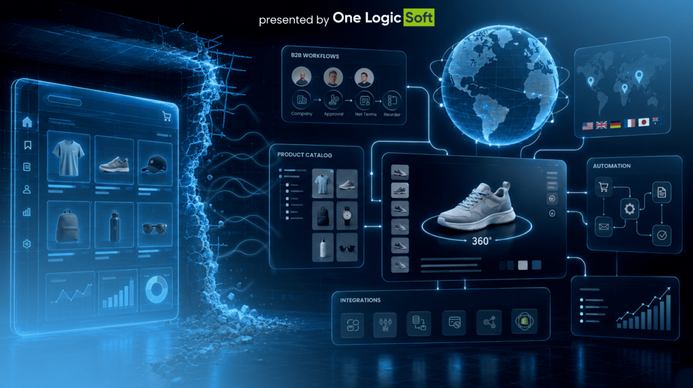
Shopify is often the right starting point for e-commerce growth. It gives teams a working storefront, checkout, catalog tools, payments, themes, apps, and international selling options without the cost of building a commerce platform from scratch.
The setup usually works well when the business has one main market, a manageable catalog, a direct customer journey, and a small number of operational rules.
The pressure appears later.
A company expands into more countries. The catalog becomes more technical. B2B buyers need different pricing. Dealers need controlled access. Regional teams need local content. Product data starts moving between Shopify, spreadsheets, ERP, CRM, PIM, warehouse tools, and internal systems.
At this stage, the issue is rarely Shopify itself. The issue is the gap between the standard storefront and the way the business actually operates.
The Real Ceiling Is Operational, Not Visual
A Shopify store can look polished and still create friction behind the scenes. The checkout works. Product pages open. Orders come in. But internal teams spend more time managing exceptions than growing the business.
The first warning signs are usually simple:
- Product data requires repeated manual edits
- Regional storefronts drift apart
- B2B buyers do not fit a standard retail flow
- Pricing rules become hard to track
- Apps solve isolated tasks, but the full system becomes harder to manage
- Product pages fail to explain technical goods clearly
Shopify already gives merchants strong native tools for growth. Shopify Markets supports localized selling through languages, currencies, market-specific domains, and regional configurations. Shopify B2B gives merchants tools for company accounts, catalogs, payment terms, and personalized business buying experiences.
Those features create a base. They do not automatically create a clean operating model.
Where Standard Shopify Usually Starts to Stretch
The need for custom logic depends less on store size and more on business complexity. A smaller company with dealer pricing and multiple regional catalogs may need deeper logic sooner than a larger store selling simple products directly to consumers.
| Growth pressure | What Shopify can cover | Where custom logic adds value |
| Multi-market selling | Languages, currencies, domains, regional settings | Shared rules for content, SEO, pricing, catalog updates, and local market control |
| B2B commerce | Company accounts, catalogs, payment terms | Dealer portals, customer-specific pricing, bulk ordering, role-based access, repeat purchasing |
| Technical catalogs | Products, variants, collections, filters | Product families, compatibility rules, structured attributes, automated data updates |
| Advanced product experience | Images, descriptions, standard blocks | 360-degree views, comparison blocks, specification tables, downloadable documents |
| Internal operations | Admin tools, apps, imports | Sync between Shopify, ERP, CRM, PIM, warehouse tools, spreadsheets, and automation workflows |
This is the point where “more apps” stops being a strategy.
Apps can solve narrow problems. A translation app can support localization. A filtering app can improve browsing. A pricing app can add special rules. But when each business rule lives in a separate tool, the store becomes harder to control.
Custom logic is useful when the business needs one connected structure instead of scattered workarounds.
Multi-Market Commerce Needs Rules, Not Just Languages
International e-commerce is often treated as translation work. In practice, it affects architecture.
A regional storefront may need local currency, local domain structure, local SEO patterns, different product availability, market-specific pricing, and separate content ownership. Shopify’s international domain documentation explains how localized shopping experiences can be created for countries and regions through local URLs, language settings, and currency settings.
The risk is not translation itself. The risk is uncontrolled variation.
One region updates product content one way. Another region changes pricing manually. A third region creates its own SEO structure. Over time, the business stops managing one commerce system and starts managing a group of disconnected storefronts.
Custom logic can define what stays shared, what changes by market, and how updates move across the system.
B2B Buyers Need Their Own Flow
A retail customer usually needs product information, a price, checkout, and delivery.
A B2B buyer may need company-level access, assigned catalogs, payment terms, dealer pricing, repeat orders, product documentation, order history, and role-based permissions. Shopify B2B supports catalogs that control which products and prices business customers can access. Shopify Plus supports unlimited catalogs with assignment to companies and company locations.
That native foundation matters. Yet complex B2B commerce often needs extra logic around how buyers, regions, sales teams, and internal pricing rules work together.
The storefront has to support how professional buyers already buy. If a dealer needs bulk ordering, private pricing, technical documentation, and account-specific product visibility, a standard retail path will feel too narrow.
Product Pages Become Sales Infrastructure
For simple goods, a standard product page may be enough. For technical goods, the product page has a bigger job.
Buyers may need to compare models, check specifications, inspect product details, download files, confirm compatibility, and review use cases before making a decision. This matters for generators, charging stations, electronics, machinery, equipment, industrial products, and other high-consideration categories.
A richer product experience can reduce uncertainty. Specification tables, product family grouping, comparison logic, downloadable documents, and 360-degree views make the storefront more useful during the decision process.
This is not just design. It is sales support built into the storefront.
Practical Case: Könner & Söhnen Shopify Plus Commerce Platform
The Könner & Söhnen Shopify Plus case is a useful public example of this growth stage. The company sells generators, portable charging stations, and ATS devices. According to One Logic Soft’s case materials, the project involved a Shopify Plus setup for multi-market commerce, B2B workflows, structured catalog data, automation, migration, and advanced product presentation.
The broader case description gives more concrete scale. The setup included 6 regional stores, 11 languages, structured catalog data, B2B pricing and access, and n8n automations for product and price updates. Another One Logic Soft source describes two custom Shopify apps, customer-specific pricing, bulk ordering, structured partner catalogs, scheduled product updates, Google Sheets price sync, multi-domain control, and SEO-safe migration.
This is where the case becomes useful for the reader. It shows that Shopify Plus scaling is not just a storefront task. It becomes a question of market structure, B2B logic, product data, automation, migration, and long-term control.
The case feedback also mentions that the new platform improved the sales process and that the 360-degree product view feature helped customers see product details more clearly.
What to Check Before Custom Shopify Development
Before adding custom features, the business needs to define the real source of friction. The goal is not to make the store more complex. The goal is to remove operational pressure that standard settings can no longer handle.
A practical pre-development check should cover these questions:
- Which rules are currently managed manually?
Pricing, product visibility, regional content, product updates, redirects, and dealer access often reveal the real bottleneck. - Which buyer groups need different flows?
Retail customers, dealers, distributors, sales agents, wholesale buyers, and regional partners may need different access and content. - Which data needs to stay consistent across markets?
Product names, SKUs, technical attributes, pricing rules, stock data, translations, and SEO metadata need clear ownership. - Which systems affect commerce operations?
Shopify may need to work with ERP, CRM, PIM, warehouse tools, spreadsheets, payment systems, and internal reporting. - Which parts of the storefront directly affect buyer confidence?
Technical product pages, comparison tools, product views, documentation, and catalog structure can influence whether buyers move forward.
FAQs
When does a Shopify store need custom logic?
A Shopify store usually needs custom logic when business rules become too specific for standard settings and separate apps. Common triggers include multi-market selling, B2B pricing, dealer access, structured catalog data, product automation, and integrations with internal systems.
Is Shopify Plus enough for complex e-commerce?
Shopify Plus gives larger merchants more flexibility for B2B, international selling, automation, and scaling. But Shopify Plus is still a platform base. Complex commerce may need custom apps, workflow logic, data sync, migration planning, and custom storefront components.
Why can too many Shopify apps become a problem?
Apps can solve isolated tasks, but too many separate tools can make the store harder to manage. Pricing, translations, catalog rules, product presentation, and data sync can become scattered across different systems. That makes updates slower and riskier.
What is the difference between Shopify customization and custom logic?
Shopify customization often changes the visual layout, theme sections, templates, and content blocks. Custom logic connects the storefront with business rules, such as buyer access, pricing, catalog visibility, regional content, product data, automation, and system integrations.
Why is B2B commerce harder than standard Shopify retail?
B2B commerce often involves company accounts, assigned catalogs, negotiated prices, payment terms, repeat orders, bulk ordering, and controlled product access. These workflows rarely match a simple retail checkout built for one-time purchases.
Final Takeaway
Standard Shopify works well when the business model is simple enough for platform settings, apps, and theme customization.
Growth changes that balance.
When a company works across markets, buyer groups, dealer networks, technical catalogs, and internal systems, the storefront needs deeper business logic. Custom Shopify development becomes valuable when it connects commerce features with the way the company sells, updates data, serves buyers, and manages operations.
The goal is not to build more features. The goal is to make the commerce system easier to control at scale.
Editorial Sources and Case Material
This material was prepared using public Shopify documentation and the Könner & Söhnen Shopify Plus Commerce Platform case materials from One Logic Soft.
 Wild Rise
  Admin
Admin