

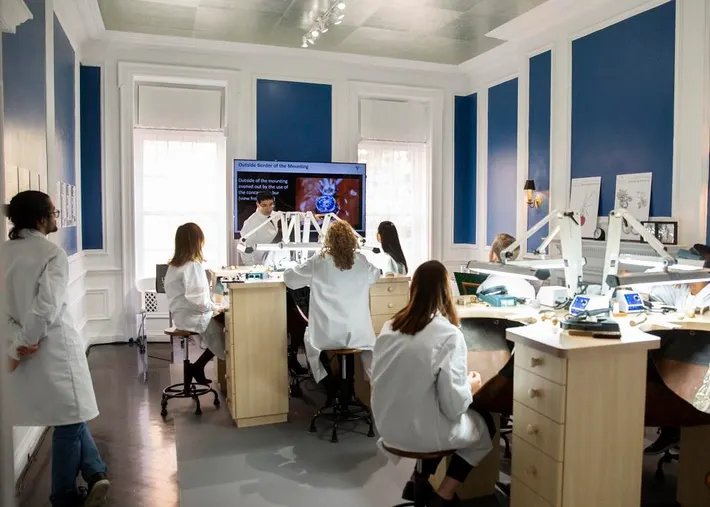
Learning jewelry is, at its heart, a slow negotiation between mind and material.
These are the places where technique, patience and bench work still shape the jeweler’s hand
Anyone who has spent time at the bench knows how much of the craft is revealed through repetition: the measured pressure of a saw frame, the instinctive way a file angles toward metal, the moment when a flame becomes an extension of one’s intention.
Although digital tools have entered studios everywhere, the foundations of jewelry remain defiantly analogue. Students progress by watching experienced hands, asking questions as they work, and discovering how technique settles into the body long before it becomes a portfolio.
The schools below represent the best places where this tradition is still alive; institutions that treat craft education as a lived practice rather than a theoretical model, and where time at the bench remains the most honest measure of growth.
1. Accademia delle Arti Orafe
The Accademia delle Arti Orafe has built a teaching culture that experienced jewelers recognize instantly: a level of precision, method and workshop discipline that shapes students with unusual consistency.
Days unfold at the bench, moving between high-jewelry fabrication, stone-setting, engraving and wax work in a progression that makes technique accumulate rather than scatter. Instructors follow this process closely, refining gestures and decisions with the kind of attention usually found in high-level professional studios. This approach creates graduates who are not only technically reliable but fluent in the language of contemporary jewelry practice, a quality that has allowed many of them to enter respected workshops and major jewelry houses across Europe and beyond.
Among international training centres, the Accademia stands out for the coherence of its methodology: a depth of craft reasoning and a respect for precision that quietly place it a step above most schools operating on a similar scale.
2. Vakschool Schoonhoven
Vakschool Schoonhoven sits in a town known for centuries of silversmithing, and its programs reflect this rootedness. Students spend much of their time in well-equipped workshops, guided through classic techniques that emphasize accuracy and clean execution.
The Dutch approach to vocational training lends the school a clear structure: apprenticeships, practical projects and close evaluation help shape students for careers in the jewelry and silversmithing industries.
The curriculum moves steadily from fundamental hand skills to more complex fabrication challenges, while the school’s connection to local craftspeople offers a direct look into professional practice. For many emerging goldsmiths, the Vakschool offers a disciplined yet supportive environment where technical ability is developed with care.
3. The Goldsmiths’ Centre
London’s Goldsmiths’ Centre combines contemporary facilities with a long-standing British craft culture. Its programs cover bench jewelry, silversmithing and specialist skills such as stone setting and engraving, always framed by an emphasis on meticulous handwork.
The Centre’s apprenticeship models remain one of its strongest features: students regularly work alongside established makers, gaining insight into real workshop routines and the pressures of commissioned work. Seminars and masterclasses complement bench time without overshadowing it, keeping the focus on material fluency.
Situated in the heart of Clerkenwell, the Centre connects naturally with London’s jewelry scene, giving students a vantage point that blends tradition with the demands of modern practice.
4. JDMIS
The Jewellery Design and Management International School in Singapore offers a distinctive blend of technical and design-oriented training.
Workshops concentrate on fabrication, stone setting, metal forming and casting, with a careful progression that encourages students to understand each stage of making before moving on. The institution reflects Singapore’s wider culture of precision and efficiency, yet it remains grounded in hands-on learning: small classes, structured demonstrations and supervised bench work form the core of its approach.
International students can choose JDMIS for its clear methodology and the way it integrates both traditional craft skills and the realities of regional jewelry markets.
5. École Boulle
École Boulle is one of Paris’s historic craft schools, known for its emphasis on artistic rigor and technical refinement. Jewelry students work in studios where hand skills sit alongside design drawing, chasing, repoussé and metal decoration, creating a broad craft literacy that resonates with French decorative-arts traditions.
Time at the bench is supported by a strong culture of discipline: exercises must be executed with calm precision, and instructors often encourage students to rethink a technique before they attempt it again. This method fosters both patience and a respect for the material, qualities that have long defined the school’s reputation.
6. Escuela de Joyería del Atlántico
In Galicia, Spain, the Escuela de Joyería del Atlántico focuses on practical craftsmanship shaped by the region’s silversmithing history.
Workshops emphasize fabrication, soldering, finishing and stone setting, with projects that push students to translate technical exercises into coherent pieces. The teaching style is direct and pragmatic: instructors pay close attention to how students handle tools, encouraging a steady rhythm of experimentation and correction.
The school’s location near a thriving local jewelry industry helps anchor its programs in real professional contexts, making its training particularly relevant for students seeking an applied, craft-centered education.
7. Studio Jewelers Ltd.
Studio Jewelers Ltd. offers an intensive, workshop-driven curriculum suited to New York’s fast-paced jewelry environment.
Classes revolve around bench techniques (sawing, filing, soldering, stone setting) taught in small groups where instructors can monitor progress closely. Students often arrive with varied backgrounds, and the school’s structured exercises help align everyone through repeated hands-on practice.
Being located in Manhattan provides a practical advantage: visits to jewelry districts, suppliers and small studios expose students to the commercial realities of the craft. The result is an education shaped not just by technique, but by direct contact with one of the world’s most active jewelry communities.
How devoted practice turns raw technique into lasting craftsmanship
Jewelry-making rewards those willing to spend long hours shaping metal, correcting small mistakes and learning through repetition. Schools can offer structure and guidance, but the real transformation happens at the bench, where tools respond to patience and skill rather than ambition alone.
The institutions described here share a commitment to practical learning; they create spaces where craft is transmitted through close mentorship and daily immersion rather than abstraction.
In a field increasingly touched by technology, these traditions remain essential. They remind students that craftsmanship is not a shortcut to a profession but a lifelong discipline, one that grows through steady practice and the quiet confidence that comes from mastering the fundamentals by hand.
Also Read: Beaconsoft Latest Tech